A restaurant chain with 120 locations and 3,000 employees has a problem that every retail and hospitality organization shares: the people delivering the customer experience are the hardest to train. They work shifts, not desk hours. They’re on their feet, not at a computer. They turn over at rates that make annual training cycles irrelevant — by the time the yearly program rolls out, half the staff who need it have already left and been replaced by people who’ve never seen it.
This is why most retail and hospitality training fails. It’s not that the content is wrong. It’s that the delivery model was designed for office workers and forced onto frontline teams. The result: low completion, inconsistent customer experience across locations, and managers who spend more time training than leading.
Fixing this requires training built from the ground up for the realities of frontline work — mobile-first, shift-friendly, manager-led, and measured by what customers actually experience.
The five challenges unique to retail and hospitality training
Understanding why standard eLearning fails in this environment is the first step to building something that works.
The first challenge is turnover. Retail and hospitality turnover averages 60% to 80% annually. Some quick-service restaurants exceed 100%. This means your onboarding program isn’t a one-time investment — it’s running continuously. Every month, new employees enter the system needing to reach competency fast. A six-week onboarding program is a luxury most locations can’t afford. The target is days, not weeks.
The second challenge is access. Frontline employees don’t have company laptops or dedicated training time. They have phones and five-minute gaps between rushes. Training that requires a desktop computer, a quiet room, and 45 uninterrupted minutes will never reach the people who need it most. Mobile-first isn’t a nice-to-have. It’s the only viable delivery channel.
The third challenge is consistency across locations. A guest visiting location 47 should have the same experience as a guest visiting location 3. But when training is delivered by individual managers with different interpretations, different emphasis, and different standards, the guest experience varies wildly. The gap between your best location and your worst location is a training problem — not a people problem.
The fourth challenge is manager bandwidth. In most retail and hospitality environments, the location manager is responsible for training on top of operations, scheduling, inventory, and guest issues. Training is always the first thing that gets deprioritized when the lunch rush hits or someone calls in sick. Programs that depend entirely on manager-led delivery are programs that get delivered inconsistently.
The fifth challenge is measurement. Most organizations can tell you whether employees completed the training. Almost none can tell you whether the training improved the guest experience. Without connecting training completion to operational metrics — guest satisfaction scores, complaint rates, speed of service, upsell percentages — you can’t prove the investment is working or identify where it’s falling short.
What effective retail and hospitality training looks like
Programs that work in this environment share four design principles that are fundamentally different from traditional corporate eLearning.
The first principle is micro-delivery. Modules run 3 to 7 minutes, not 30 to 60. Each one covers a single skill or scenario: how to handle a guest complaint, how to describe today’s special, how to process a return, how to spot a safety hazard. Short enough to complete during a break. Focused enough to apply immediately on the floor.
The second principle is mobile-native design. Not responsive — mobile-native. The content is designed for a phone screen first, with thumb-friendly interactions, minimal text, visual demonstrations, and offline capability for locations with unreliable Wi-Fi. If your eLearning requires pinch-to-zoom to read the text, it wasn’t designed for this audience.
The third principle is scenario-based practice that mirrors the floor. A cashier watching a video about upselling learns what upselling looks like. A cashier practicing an upsell conversation in a branching scenario — where the simulated guest responds with hesitation, asks about price, or says no — learns how to actually do it. The practice is what transfers to the job. The video alone doesn’t.
The fourth principle is manager-supported, not manager-dependent. The training system handles content delivery, assessment, and tracking. The manager’s role shifts from trainer to coach: observing on-the-job application, providing feedback, and reinforcing key behaviors. This is sustainable because it doesn’t add hours to the manager’s day. It replaces informal training with structured observation.
Building an onboarding program for high-turnover environments
Onboarding is the highest-impact training investment in retail and hospitality because every single new hire goes through it — and with turnover rates above 60%, you’re onboarding continuously.
The most effective frontline onboarding programs follow a compressed, phased structure. Day one is orientation — company values, safety basics, systems access, and knowing who to ask when you’re stuck. This should take two hours, not two days. The goal is confidence and safety, not mastery.
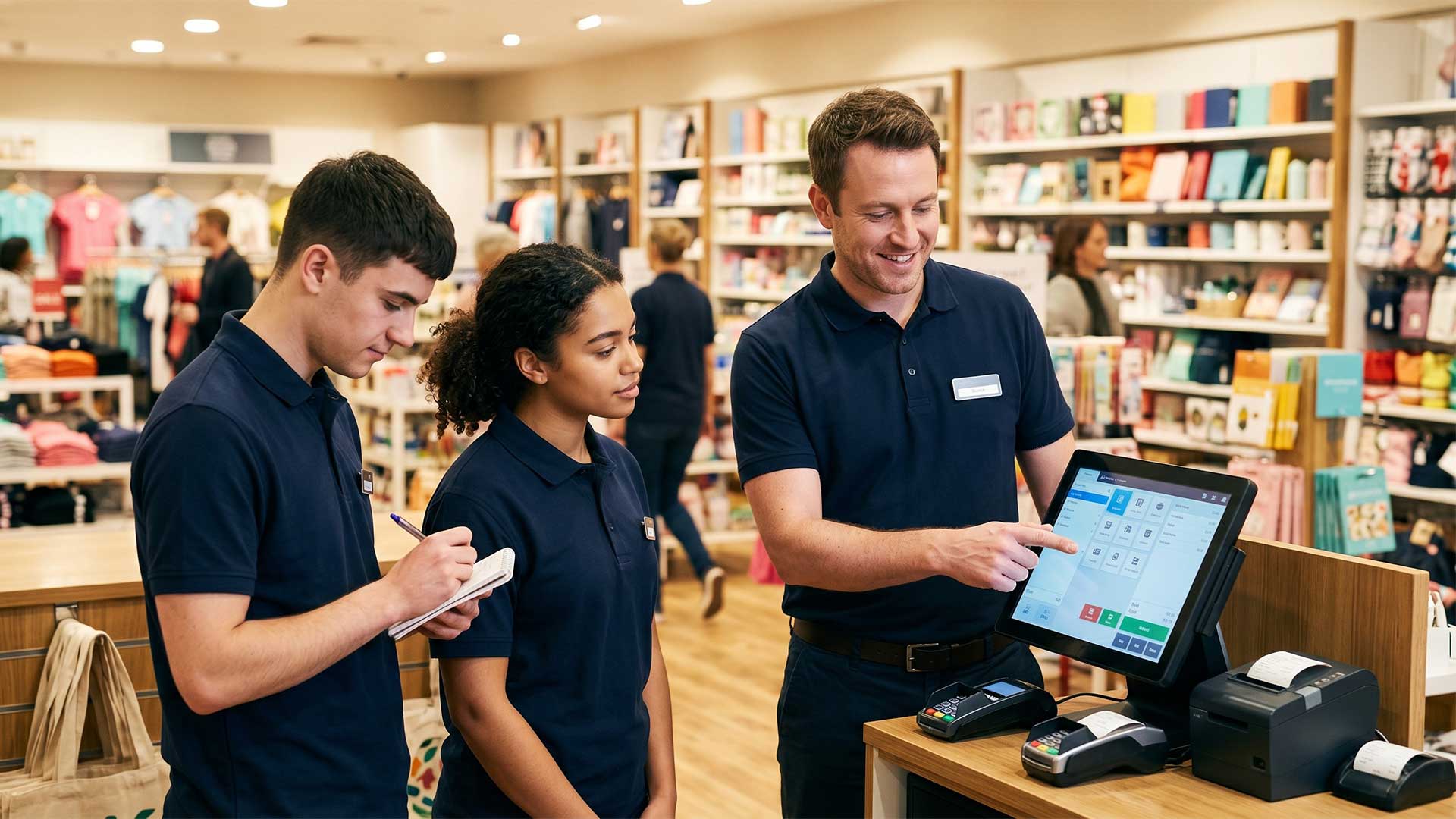
Days two through five are role-specific skill building. Short mobile modules on core tasks, paired with on-the-floor shadowing and manager observation. A knowledge check at the end of each day confirms the employee is ready for the next level of responsibility. This gated progression prevents the common problem of throwing new hires onto the floor before they’re ready.
Weeks two through four are reinforcement and independence. The employee is performing the role with decreasing supervision. Microlearning modules cover edge cases — handling a difficult guest, managing a busy period, processing an unusual transaction. A competency assessment at the end of week four confirms floor-readiness.
The target is full productivity in three to four weeks. A national restaurant chain we worked with reduced this from four weeks to three using this structure — while simultaneously reducing guest complaints by 23% in the first 90 days, because new employees were better prepared before they interacted with guests independently.
Solving the consistency problem across locations
The gap between your best and worst locations is almost always a training and management problem. Two approaches close it.
The first is centralized content with localized delivery. Core training — brand standards, food safety, guest service protocols — is built once and delivered identically to every location through the LMS. This eliminates the game of telephone where each manager interprets the standards differently. When every employee at every location sees the same scenarios and passes the same assessments, baseline consistency improves measurably.
The second is location-level performance dashboards. When general managers can see their location’s training completion alongside guest satisfaction scores and operational metrics — and compare to other locations — training stops being an abstract HR requirement and becomes a performance lever. The locations with the highest completion rates and assessment scores should also have the best guest metrics. If they don’t, the content needs revision. If they do, the data makes the case for training investment better than any presentation.
Compliance training that frontline teams actually complete
Food safety, workplace safety, harassment prevention, and cash handling — these aren’t optional. But compliance training designed for office environments fails spectacularly on the floor. A 45-minute harassment prevention module delivered once a year produces a completion checkbox and zero behavior change.
Effective frontline compliance training follows the same micro-delivery principles: short modules, mobile-friendly, scenario-based. But it adds two elements that standard compliance training lacks.
The first is frequency. Instead of annual delivery, compliance refreshers are distributed monthly — a five-minute scenario each month that reinforces a different compliance topic. Over 12 months, every topic is covered with significantly better retention than a single annual marathon.
The second is situational relevance. A food safety scenario should take place in a kitchen that looks like the employee’s kitchen, with situations they actually encounter — not a generic stock photo of someone washing their hands. A harassment prevention scenario should involve the power dynamics that exist in restaurant or retail environments, not a generic office setting.
Measuring what matters: connecting training to guest experience
The ultimate measure of retail and hospitality training isn’t completion rates. It’s whether guests have a better experience.
Four metrics connect training to business outcomes. Guest satisfaction scores — tracked by location, compared before and after training rollout. Guest complaint rates — particularly in the first 90 days after a new hire joins, when training quality has the most direct impact. Speed of service — for roles where efficiency matters, training should measurably reduce time-to-competency. Revenue per transaction — for roles with upsell responsibility, effective training should move this number.
Track these alongside training metrics — completion rates, assessment scores, time-to-competency — and you build a picture that connects the training investment to the business result. When a location’s guest satisfaction score improves 14 points after a training rollout while a control location remains flat, that’s the evidence that justifies expanding the program.
The ROI math for high-turnover training
The math is different in retail and hospitality because turnover changes the equation. A custom onboarding program that costs $25,000 to develop and reduces time-to-floor-readiness by one week across 500 annual hires saves the equivalent of 500 employee-weeks of sub-productivity. If each week of sub-productivity costs the location $300 in lost revenue, slow service, and manager time, the annual saving is $150,000 — a 6x return on a program that runs for years.
Add the impact on turnover itself. Employees who feel confident and supported during onboarding are significantly less likely to quit in the first 90 days. If your 90-day turnover drops even five percentage points — from 35% to 30% — across 500 hires, that’s 25 fewer replacements at $2,000 to $4,000 each in recruiting and training costs.
Retail and hospitality training is one of the clearest ROI cases in corporate learning — because the volume of learners is high, the cost of poor performance is visible in every guest interaction, and the alternative is paying for the same onboarding failures over and over.