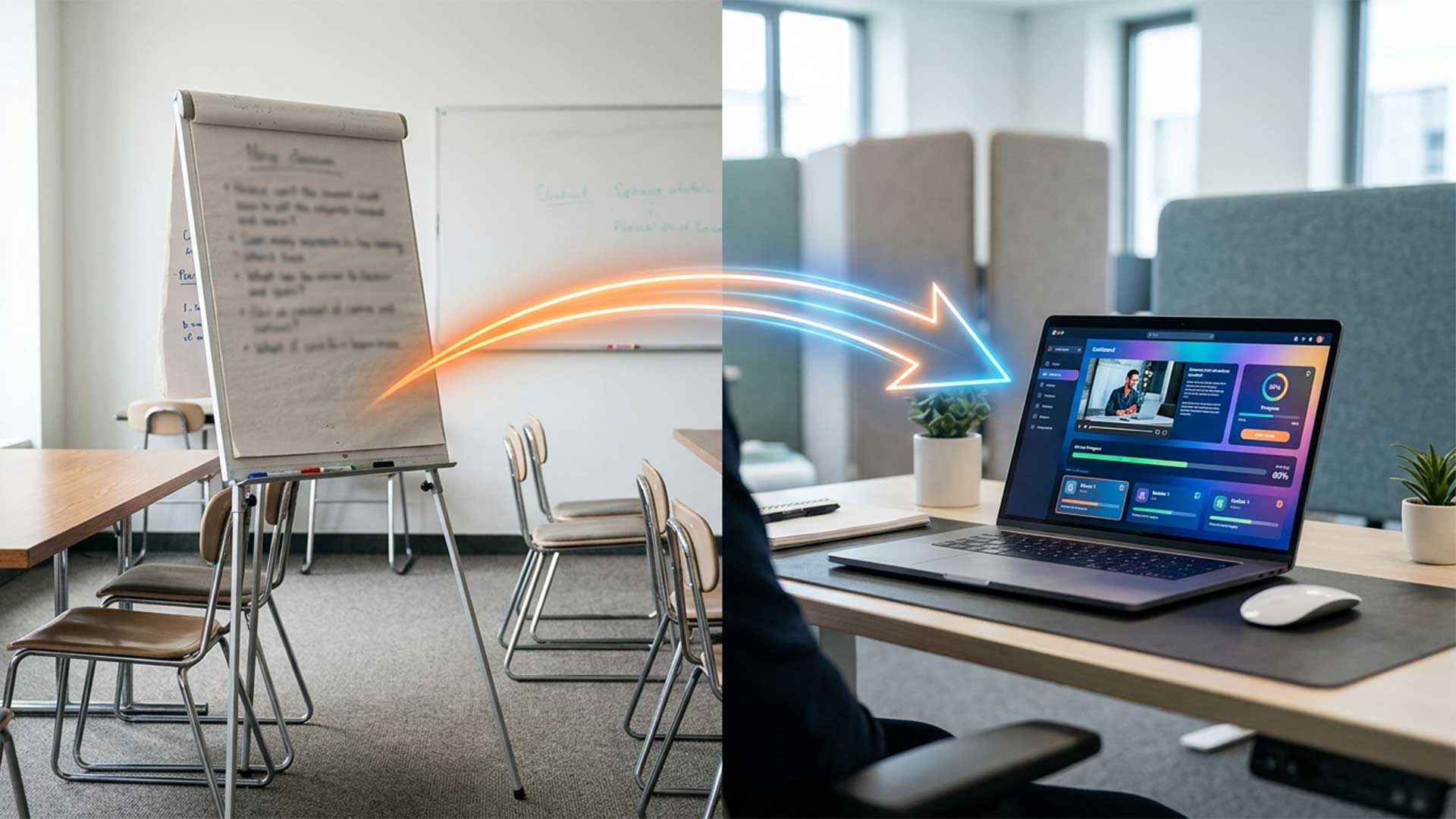
Most organizations have a library of instructor-led training that works — in the classroom. The facilitator reads the room, adjusts the pace, answers unexpected questions, and brings decades of experience to discussions that no slide deck can replicate.
Then someone asks: “Can we put this online?”
The answer is yes — but not by recording the instructor and uploading the video. Converting instructor-led training to eLearning requires redesigning the experience for a fundamentally different medium. What works in a classroom with a skilled facilitator often fails in a self-paced environment where the learner is alone with the content.
Here’s how to convert effectively — preserving what made the instructor-led version work while using what digital delivery does better.
What you’re actually converting — and what you’re not
The first step is understanding that you’re not converting slides to screens. You’re converting a learning experience from one medium to another. The slides were never the training — the instructor was. The discussions were. The real-time examples were. The ability to ask a question and get an immediate, contextual answer was.
When you strip away the instructor, you strip away the adaptive engine that made the training work. Your eLearning needs to replace that adaptiveness with something else — and that something is instructional design.
Before you start, audit the existing instructor-led program. Identify what the instructor adds that the content doesn’t. Where do they tell stories that make concepts concrete? Where do they adjust the explanation when faces go blank? Where do they facilitate discussions that build shared understanding? These are the moments that need creative translation — not just content transfer.
Separate content types before you design
Not everything in an instructor-led program should become eLearning. Some content converts naturally. Some needs a different modality entirely.
Factual knowledge and procedures convert well to self-paced eLearning. Definitions, processes, system navigation, policy information — these are best learned at the individual’s own pace with the ability to revisit as needed. The instructor-led version probably spent too much live time on these because there was no self-paced alternative.
Application and judgment convert to scenario-based eLearning. Where the instructor used case studies and discussion to build judgment, you build branching scenarios where learners make decisions and see consequences. The interactivity replaces the discussion — not perfectly, but sufficiently for most contexts.
Complex discussions and nuanced debate don’t convert well to self-paced formats. If the instructor-led session included a 30-minute facilitated debate on ethical gray areas, that discussion requires human interaction. Keep these as live sessions — virtual or in-person — and build the eLearning around them as pre-work and reinforcement.
Design for the self-paced learner — not the classroom
Classroom learners have an instructor pacing the experience, a cohort creating social accountability, and a scheduled time block with no competing tasks. Self-paced learners have none of these. They’re fitting training between meetings, they’re alone, and every notification on their screen is a competing priority.
This means eLearning needs to be tighter, more engaging per minute, and more respectful of time than instructor-led training. A 4-hour classroom session does not become a 4-hour eLearning course. It becomes a 60 to 90 minute eLearning experience that covers the same objectives more efficiently — because there’s no time spent on logistics, tangential discussions, or waiting for the slowest learner to catch up.
Design in short sections of 10 to 15 minutes that can be completed independently. Each section should have a clear objective, active engagement within the first two minutes, and a knowledge check before the learner moves forward. If a learner can close the module after any section and return later without losing context, you’ve designed for how self-paced learning actually happens.
Replace the instructor’s adaptiveness with smart design
The hardest thing to replicate in eLearning is the instructor’s ability to adapt in real time. You can’t fully replace it — but you can approximate it with three design strategies.
Branching pathways let the content adapt to the learner’s level. If a learner passes a pre-assessment on foundational concepts, they skip to advanced content. If they struggle with a knowledge check, they get additional explanation before progressing. The learner experiences a path that feels personalized without requiring an instructor.
Contextual feedback replaces the instructor’s real-time explanations. When a learner makes an incorrect choice in a scenario, the feedback doesn’t just say “incorrect.” It explains why the choice was wrong, what the correct approach is, and what the consequence would be in a real-world context. Good feedback teaches — it doesn’t just evaluate.
Optional depth layers let advanced learners dig deeper without slowing down others. Expandable sections, “learn more” resources, and supplementary examples give motivated learners the richness they’d get from asking the instructor questions — without forcing every learner through the same level of detail.
Pilot with the original instructor
The most valuable quality check for a converted program is having the original instructor review and test it. They know where learners typically struggle, what questions always come up, and what the training needs to accomplish at each stage.
Have the instructor go through the eLearning as if they were a learner. Ask them: does this cover what I cover in the classroom? Where would my students get confused? Where would they disengage? What’s missing that I always address in discussion?
Their feedback will reveal gaps that no amount of instructional design review can catch — because they’ve watched hundreds of learners engage with this content in real time. That experience is irreplaceable.
Plan for what stays live
The strongest converted programs don’t eliminate live sessions entirely. They use eLearning for what eLearning does best and live sessions for what live sessions do best.
Self-paced eLearning handles knowledge building, procedure learning, basic skill practice, and assessment. Live sessions — now shorter and more focused — handle complex discussion, collaborative problem-solving, role-play, and Q&A. The instructor’s time is used for high-value facilitation instead of content delivery.
This blended approach typically reduces total instructor time by 50% to 70% while maintaining or improving learning outcomes. The instructor isn’t replaced — they’re freed to do what only a human facilitator can do.