Blended learning is one of the most effective approaches to corporate training — and one of the most commonly misunderstood. Too many organizations think “blended” means “we have some eLearning and some classroom sessions.” That’s not blended learning. That’s two separate training channels that happen to coexist.
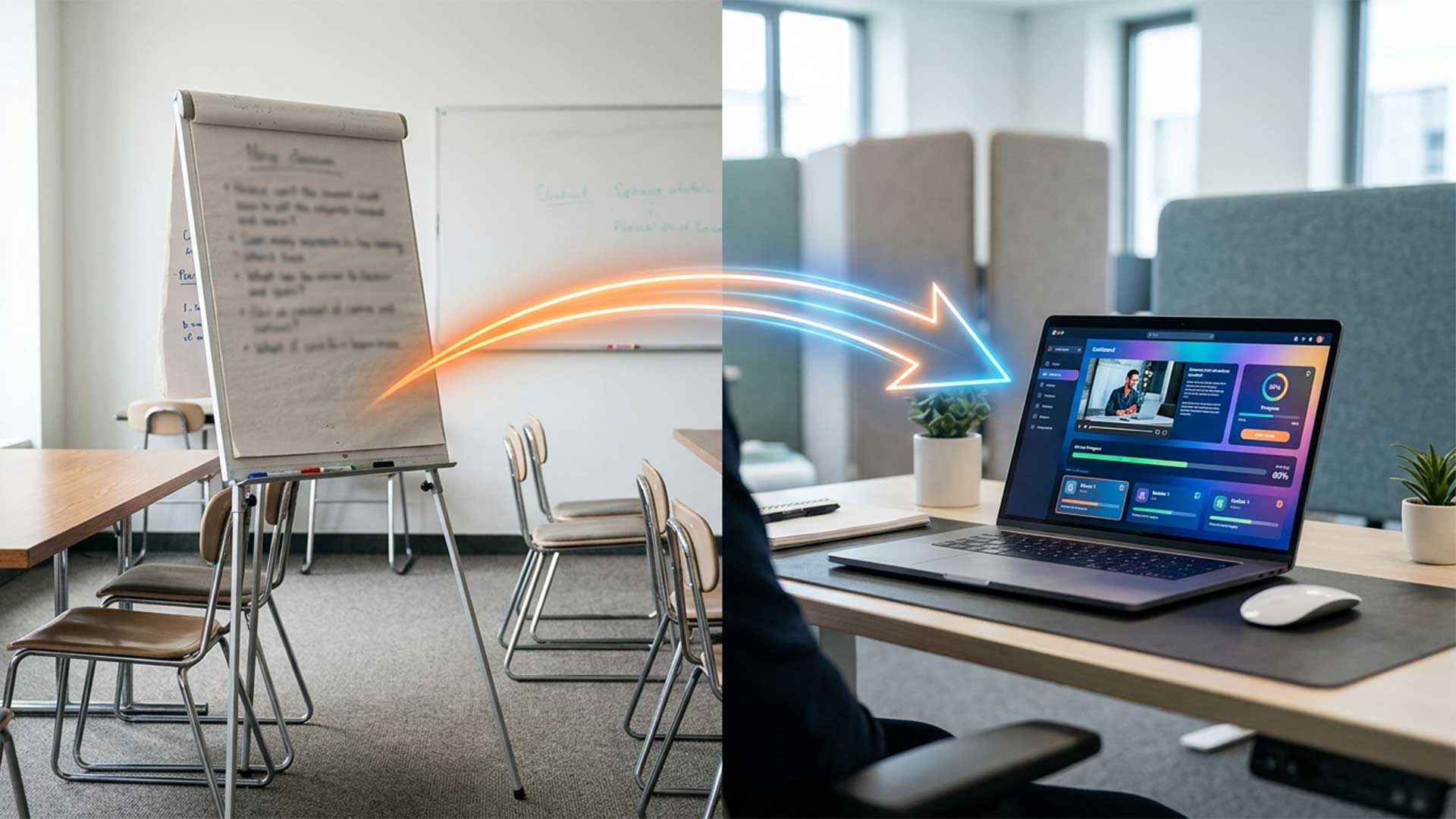
True blended learning is a deliberately designed experience where each modality plays a specific role, each one building on the others. When done right, it combines the scalability of digital learning with the depth of live interaction — and produces better outcomes than either one alone.
The core principle: match the modality to the objective
Every learning objective is best served by a specific modality. Using the wrong modality for an objective is the single most common blended learning mistake — and the reason many blended programs underperform.
Knowledge acquisition — learning facts, concepts, processes, and terminology — is best handled by self-paced eLearning. Learners can move at their own speed, revisit material as needed, and complete it when and where it works for them.
Application and practice — taking that knowledge and using it in realistic situations — requires interactive exercises. Scenario-based eLearning, simulations, role-plays, and hands-on practice sessions all live here.
Judgment and nuance — the complex, ambiguous situations where there’s no single right answer — are best served by instructor-led sessions. Discussion, case analysis, and peer learning allow for the kind of exploration that self-paced content can’t replicate.
Reinforcement — making sure the learning sticks over time — requires spaced practice. Microlearning modules, job aids, coaching check-ins, and on-the-job assignments maintain knowledge and skills after the formal program ends.
A practical framework: the four-phase model
Phase one is pre-work. Before any live session, learners complete self-paced eLearning that establishes the foundational knowledge everyone needs. This levels the playing field so live sessions don’t waste time on basics. Pre-work should take 20 to 45 minutes and include a knowledge check to confirm readiness.
Phase two is the live session. Whether virtual or in-person, the live component focuses exclusively on activities that require human interaction: discussion, collaborative problem-solving, scenario analysis, role-play, and Q&A. The critical rule: never lecture on material that was covered in the pre-work. If you do, learners will stop completing pre-work because they know it will be repeated.
Phase three is post-session application. Within one to two weeks after the live session, learners complete on-the-job assignments that apply what they learned in their real work context. These might include completing a specific task using the new process, having a coaching conversation with their manager, or documenting a situation where they applied the new skill.
Phase four is reinforcement. Over the following four to eight weeks, learners receive spaced microlearning — short modules of three to five minutes that revisit key concepts, present new scenarios, and check retention. This is where long-term behavior change happens.
The three mistakes that ruin blended programs
Mistake one: wrong modality for the objective. If you’re using a live instructor to deliver content that could be self-paced eLearning, you’re wasting the most expensive and least scalable modality on the lowest-value activity. Save live time for discussion and practice.
Mistake two: disconnected components. If the pre-work, live session, and post-session assignments don’t explicitly reference each other, learners treat them as separate unrelated events. The live facilitator should reference pre-work content directly. Post-session assignments should build on live session discussions. Every component should feel like part of one continuous experience.
Mistake three: no measurement between phases. If you don’t check whether learners completed and understood the pre-work before the live session, you’ll have a room full of people at different knowledge levels. Build knowledge checks between each phase so you can identify gaps early and intervene before they compound.
Making the case to stakeholders
Blended learning costs more to design than a single-modality program. The development investment is real. But the outcomes justify it. Blended programs consistently show higher completion rates than eLearning-only programs, stronger knowledge retention than classroom-only programs, better behavior transfer than either modality alone, and higher learner satisfaction because the variety keeps engagement high.
When presenting to stakeholders, frame it this way: each modality does what it does best, and nothing more. That’s not complexity — it’s efficiency.