You’ve read the case studies. You’ve browsed the services page. You have a training problem and you think an agency might be the right move. But you’re still wondering: what actually happens after I sign?
This article walks through the full lifecycle of a typical ID360 engagement — from the first conversation to post-launch optimization. No jargon. No sales pitch. Just a clear picture of what to expect at each stage, what we’ll need from you, and what you’ll get back.
The discovery call — before anything is signed
Every engagement starts with a 30-minute conversation. This isn’t a demo. It’s a diagnostic. We ask about the business problem you’re trying to solve, who the learners are, what you’ve already tried, and what success looks like. You ask whatever you need to — about our process, our team, our pricing, our experience in your industry.
By the end of that call, one of three things happens. We tell you we’re a good fit and send a proposal. We tell you we’re not the right partner and recommend someone who is. Or we suggest a smaller starting point — a needs analysis or pilot — because the scope isn’t clear enough yet for a full proposal.
There’s no pressure. No follow-up sales sequence. If we’re the right fit, the conversation makes that obvious.
Phase 1: Discover — weeks 1 to 3
Once we kick off, we don’t start building anything. We start listening. The Discover phase is where we make sure we’re solving the right problem.
Your dedicated team — a lead instructional designer, a senior designer, an eLearning developer, a media specialist, and a learning technology specialist — conducts stakeholder interviews with your leadership, subject matter experts, and frontline managers. We review any existing training materials, performance data, and learner feedback you can share.
The output is a project brief that defines the business problem, the target audience, the success metrics, and the recommended approach. You review it, we align, and nothing moves forward until everyone agrees on what we’re building and why.
This phase feels slow to some clients. It’s the most valuable three weeks in the project. Every shortcut taken here shows up as a revision later.
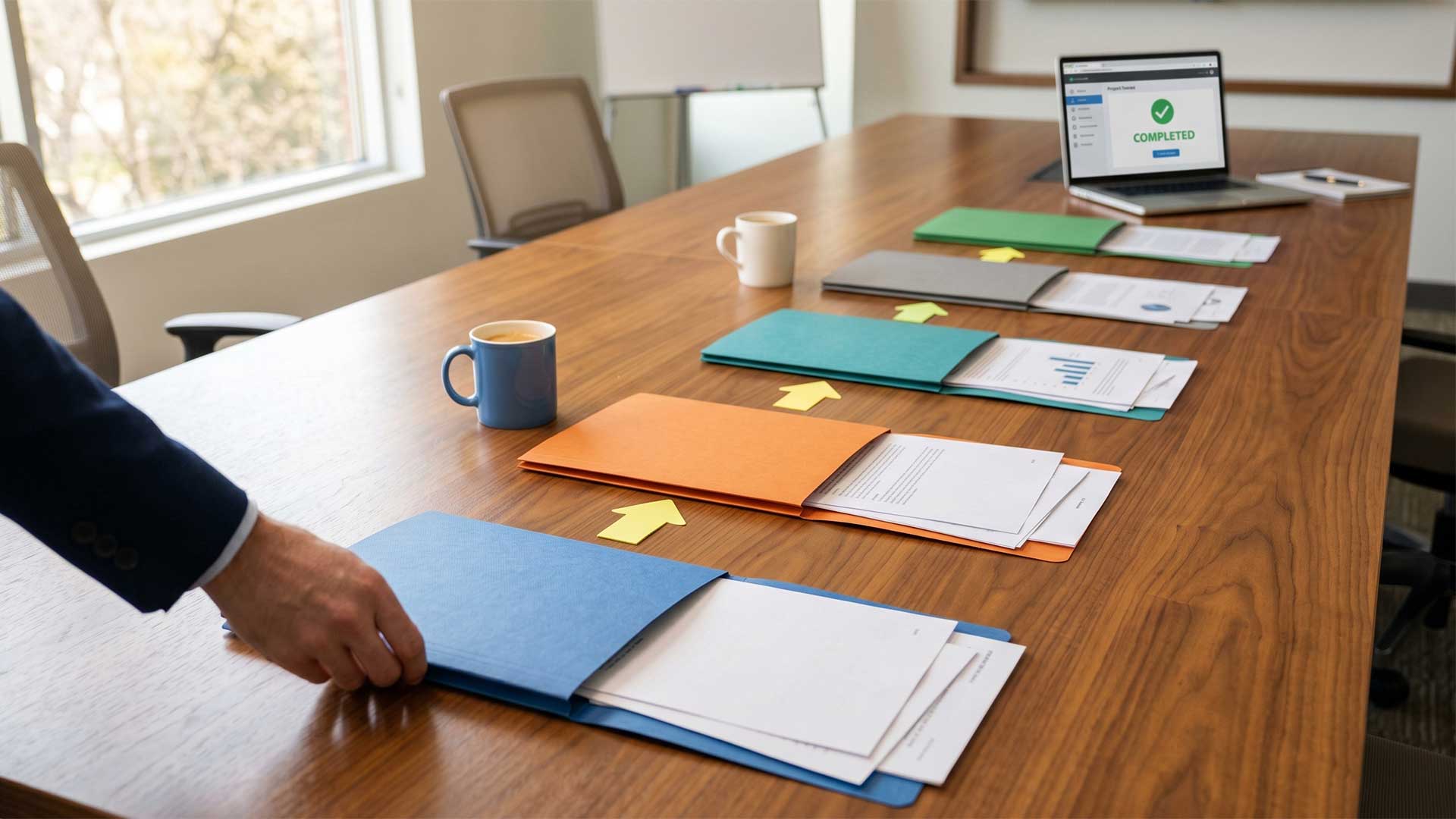
Phase 2: Design — weeks 3 to 6
With the brief approved, we architect the solution. This means writing learning objectives tied to your business outcomes, designing the content structure and sequencing, creating detailed storyboards for every module, and mapping the assessment strategy.
You see storyboards before a single screen is developed. These aren’t vague outlines — they’re detailed documents showing every interaction, every decision point, every piece of feedback the learner will experience. You review them. Your SMEs review them. We revise until the design is right.
Clients often say the storyboard review is when the project “clicks.” It’s the moment the training stops being abstract and starts feeling real.
Phase 3: Develop — weeks 6 to 10
Now we build. But not in a vacuum. Development follows an iterative cycle with checkpoints at defined intervals — typically after the first module is functional, at the halfway mark, and before final delivery.
At each checkpoint, you see working content — not mockups, not PDFs, but the actual interactive experience running in a browser. You click through it. Your SMEs verify accuracy. Your stakeholders confirm alignment. We incorporate feedback and move to the next checkpoint.
This iterative approach means there are no surprises at launch. By the time the final build is delivered, you’ve already seen and approved every piece of it in stages.
Quality assurance runs in parallel with development. Every module is tested for functionality across devices and browsers, SCORM/xAPI compliance with your LMS, WCAG 2.1 accessibility standards, and content accuracy against SME-approved source materials.
Phase 4: Deploy — weeks 10 to 12
Launch isn’t a handoff. It’s a managed process. We configure or optimize your LMS, upload all content packages, set up enrollment rules and learning paths, and build the analytics dashboards you’ll use to track performance.
Before full rollout, we run a pilot with a representative group of learners — typically 20 to 50 people. The pilot surfaces any issues with content flow, technical integration, or learner experience that testing alone can’t catch. We fix what needs fixing. Then we launch to the full audience.
Your admins get trained on the LMS configuration so they can manage the program independently. We also provide a communication toolkit — email templates, manager talking points, and learner guides — so the launch has context, not just a login link.
Phase 5: Optimize — ongoing
Thirty days after launch, we review the data together. Completion rates, assessment performance, learner feedback, time-on-task, and — most importantly — the business metrics we defined in the Discover phase.
What’s working gets reinforced. What isn’t gets revised. This isn’t a formality — we’ve changed assessment thresholds, restructured module sequences, and rewritten entire scenarios based on post-launch data.
The best training programs aren’t the ones that launch perfectly. They’re the ones that improve after launch because someone is paying attention to the data.
What we need from you
Transparency is the single biggest factor in project success. We need access to your subject matter experts for content validation. We need a decision-maker who can approve storyboards and builds without six layers of committee. We need honest feedback at every checkpoint — not just “looks good” but “this scenario doesn’t reflect how our people actually handle this situation.”
Most clients spend 3 to 5 hours per week on the project during the Design and Develop phases, less during Discover and Deploy. It’s not zero involvement — but it’s manageable, and it produces a result that’s actually yours.
What you get at the end
A training program that’s built around your business problem. Modules that work on any device, in any LMS. Assessment data that proves whether learners are ready. Dashboards that show leadership what the investment produced. And a team that’s accountable for the outcome — not just the deliverable.
Tell us about your project and we’ll start with that 30-minute conversation.