Most sales training teaches reps what to say. It doesn’t teach them how to sell. The difference shows up in every metric that matters: reps who can recite product features but can’t connect them to a prospect’s pain. Reps who freeze when an objection goes off-script. Reps who demo the same way for every buyer regardless of role, industry, or buying stage. The product knowledge is there. The selling skill isn’t.
This gap is expensive. A sales rep who takes 90 days to ramp instead of 45 is 45 days of missed quota. A rep who defaults to feature-listing instead of consultative positioning loses deals to competitors who ask better questions. A team that can’t handle the top five objections confidently leaves revenue on the table every single week.
Sales enablement training that actually moves numbers doesn’t look like a product knowledge course with a quiz at the end. It looks like practice — simulated customer conversations, realistic objection handling, and scenario-based decision-making that builds the judgment reps need before they’re in front of a real buyer.
Why product knowledge alone doesn’t produce sales performance
Every sales organization invests in product training. New reps learn the features, the pricing, the competitive landscape, the technical specifications. They pass the assessment. They’re “certified.” And then they get on their first real call and struggle — because knowing the product and selling the product are fundamentally different skills.
Product knowledge is necessary but insufficient. A rep who knows every feature of the platform but can’t identify which three features matter to this specific buyer isn’t consultative — they’re a talking brochure. A rep who can explain the technical architecture but can’t translate it into business value for a non-technical buyer loses the room. A rep who memorized the objection handling playbook but has never practiced delivering those responses under pressure will fumble when the moment arrives.
The gap isn’t knowledge. It’s application. And application is built through practice, not through slides.
The three skills that separate quota-hitting reps from everyone else
When you study the reps who consistently hit quota versus those who don’t, three skills differentiate them — and all three are trainable.
The first is consultative positioning. Top reps don’t lead with what the product does. They lead with the problem the buyer has — and they position the product as the solution to that specific problem. This requires understanding the buyer’s industry, role, and pain points well enough to connect features to outcomes in real time. It’s not a script. It’s a skill that develops through practice.
The second is objection handling. Every product faces predictable objections — price, timing, competitive alternatives, internal resistance to change. The reps who handle these confidently don’t wing it. They’ve practiced. They’ve heard the objection in a training scenario, formulated a response, received feedback, and refined their approach before encountering it with real money on the line.
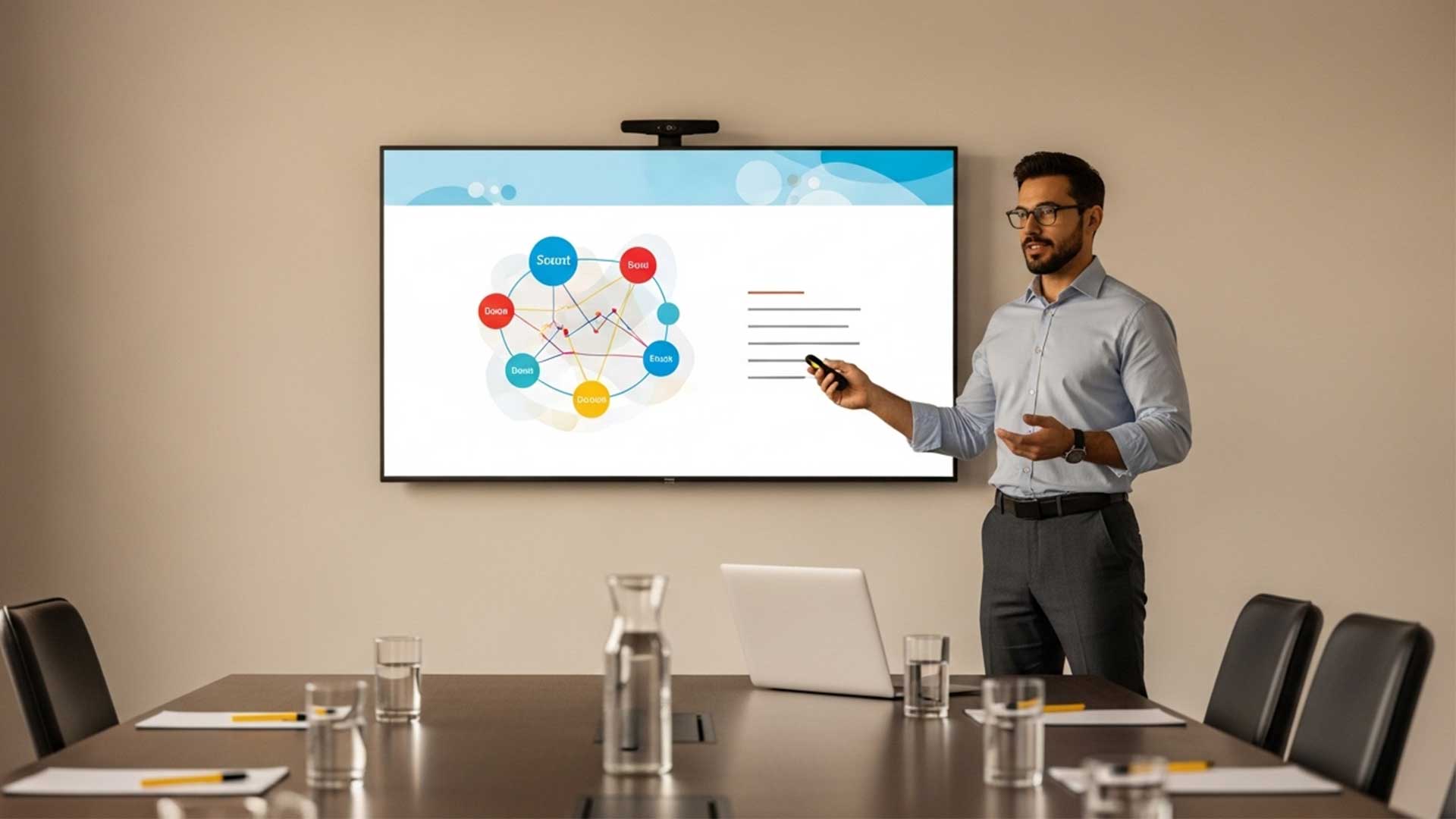
The third is adaptive demonstration. The worst demos are the ones that follow the same script regardless of the buyer. The best demos are tailored in real time — the rep reads the room, skips features that aren’t relevant, digs deeper on the ones that resonate, and tells a story that maps the product to the buyer’s specific workflow. This isn’t a talent. It’s a trained skill that comes from practicing multiple demo paths and receiving feedback on which choices work.
Scenario-based sales training — how to build it
If the three critical skills are consultative positioning, objection handling, and adaptive demonstration, the training method is scenario-based practice. Not role-play with a manager who’s too busy to give real feedback. Not a video of a perfect call that reps watch and forget. Interactive scenarios that put the rep in a realistic selling situation and require them to make decisions with consequences.
A good sales scenario starts with a buyer profile — their industry, their role, their current challenge, and their buying stage. The rep enters a simulated conversation where they choose how to open, which discovery questions to ask, how to position the product, and how to respond when the buyer pushes back. Each choice leads to a different outcome: the conversation advances, stalls, or closes.
The power of this approach is that reps experience the consequences of their choices in a safe environment. A rep who leads with features in the scenario sees the buyer disengage. A rep who asks the right discovery question first sees the conversation open up. The feedback is immediate, contextual, and memorable — because the rep made the decision, not just read about what decision to make.
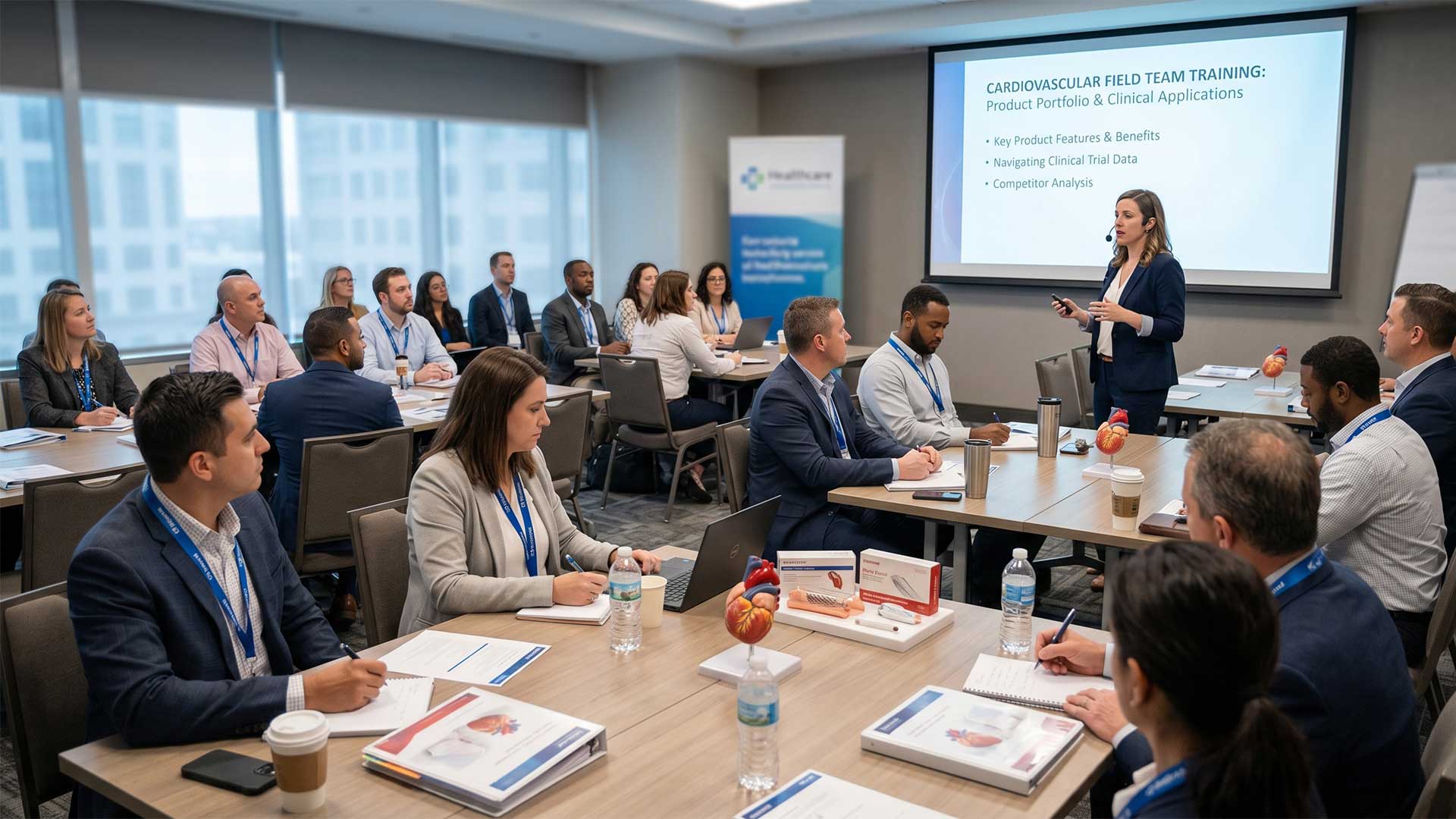
For pharmaceutical and medical device sales, this approach is especially powerful. Field reps need to handle clinical objections from healthcare providers who have deep domain expertise and limited time. A training module that places the rep inside a simulated clinic conversation — complete with provider skepticism, competing product mentions, and preparation-versus-reconstitution tradeoffs — builds the confidence that static materials never develop. Reps who’ve practiced the conversation handle it differently than reps who’ve read about it.
Onboarding new reps faster
Sales rep onboarding is one of the highest-stakes training investments in any organization. Every day a rep isn’t selling is a day of lost revenue. And the typical approach — two weeks of classroom training followed by months of shadowing and sink-or-swim — produces reps who are technically oriented but practically unprepared.
Structured sales onboarding compresses ramp time by sequencing the learning. Week one covers company context, market positioning, and the buyer personas the rep will encounter. This isn’t a nice-to-have orientation — it’s the strategic foundation that makes product training stick. A rep who understands why the product exists learns the features faster than one who memorizes them in isolation.
Weeks two through four deliver product and process training through interactive modules — CRM workflow simulations, demo practice with branching scenarios, and competitive positioning exercises. Knowledge checks at each stage verify the rep is ready before they move forward. No more hoping they absorbed it. The data confirms it.
Months two and three shift to supervised selling — real prospect interactions with coaching, call reviews, and scenario-based assessments that test applied judgment. The manager has a readiness dashboard showing exactly where each rep stands against defined competency milestones.
The result isn’t just faster ramp. It’s more consistent ramp. When every rep goes through the same structured program, performance variance across the team decreases — and the bottom of the team comes up significantly.
Keeping sales teams current without disrupting selling time
Product updates, new competitive entrants, pricing changes, new case studies, updated messaging — the information sales teams need to stay current is constant. The challenge is delivering it without pulling reps out of their selling day.
Microlearning works particularly well for ongoing sales enablement. Five-minute modules delivered weekly or biweekly that cover one topic — a new feature’s positioning, a competitive response to a new entrant, a customer success story that demonstrates value. Short enough to complete between meetings. Focused enough to be immediately useful on the next call.
Pair this with quarterly scenario assessments that test whether the team is applying the updates. If a new competitive response was trained in March, a scenario in April that puts the rep in a simulated conversation with a prospect who mentions the competitor reveals whether the training transferred. If it didn’t, you know which specific topic needs reinforcement — without waiting for the pipeline data to tell you six months later.
CRM proficiency as a sales training priority
This is the training need that most sales leaders underestimate. A CRM that reps don’t use correctly produces pipeline data that leadership can’t trust. Forecasts become guesses. Opportunity stages are meaningless because reps categorize them inconsistently. Customer data quality degrades because reps take shortcuts on data entry.
CRM training is most effective when it’s simulation-based — reps work through the actual workflows they’ll perform daily in a replicated environment. Log in, navigate to a customer account, customize the view, schedule a visit, document a sales activity, update an opportunity stage. Each step includes real-time error feedback so reps build muscle memory before touching the live system.
One global company rolling out a proprietary CRM to its sales force saw a 22% reduction in support escalations in the first quarter after deployment — because reps had practiced every workflow in a simulation before they encountered the live platform. The training eliminated the adoption dip that usually follows a CRM rollout.
Measuring sales training impact
Sales has the advantage of rich, quantifiable performance data. The challenge isn’t finding metrics — it’s connecting them to training.
Time-to-first-deal measures onboarding effectiveness. If new reps previously closed their first deal at day 75 and structured onboarding brings that to day 45, the training accelerated revenue generation by a full month per hire.
Quota attainment at 90 and 180 days reveals whether reps are ramping faster. Compare cohorts who went through the structured program against previous cohorts who didn’t. The data either validates the investment or identifies where the program needs refinement.
Objection handling success rates — measured through call recording analysis, deal stage progression, or scenario assessment scores — show whether reps are applying what they learned. A rep who scores well on a competitive objection scenario but still loses competitive deals needs coaching, not more training. A rep who scores poorly needs the training reinforced.
Deal velocity and average deal size indicate whether consultative positioning is working. Reps who sell on value rather than features close faster and close larger — because they’re solving a problem, not discounting a product.
Win rate against specific competitors is the sharpest metric for competitive training effectiveness. If your win rate against Competitor X improves from 35% to 48% after a targeted competitive module, the training produced a measurable revenue impact.
Establish baselines before the program launches. Measure at 30, 60, and 90 days after. Present the results in revenue language, not training language. Leadership doesn’t care about completion rates. They care about pipeline, quota, and revenue. Connect the training to those numbers and the budget conversation takes care of itself.