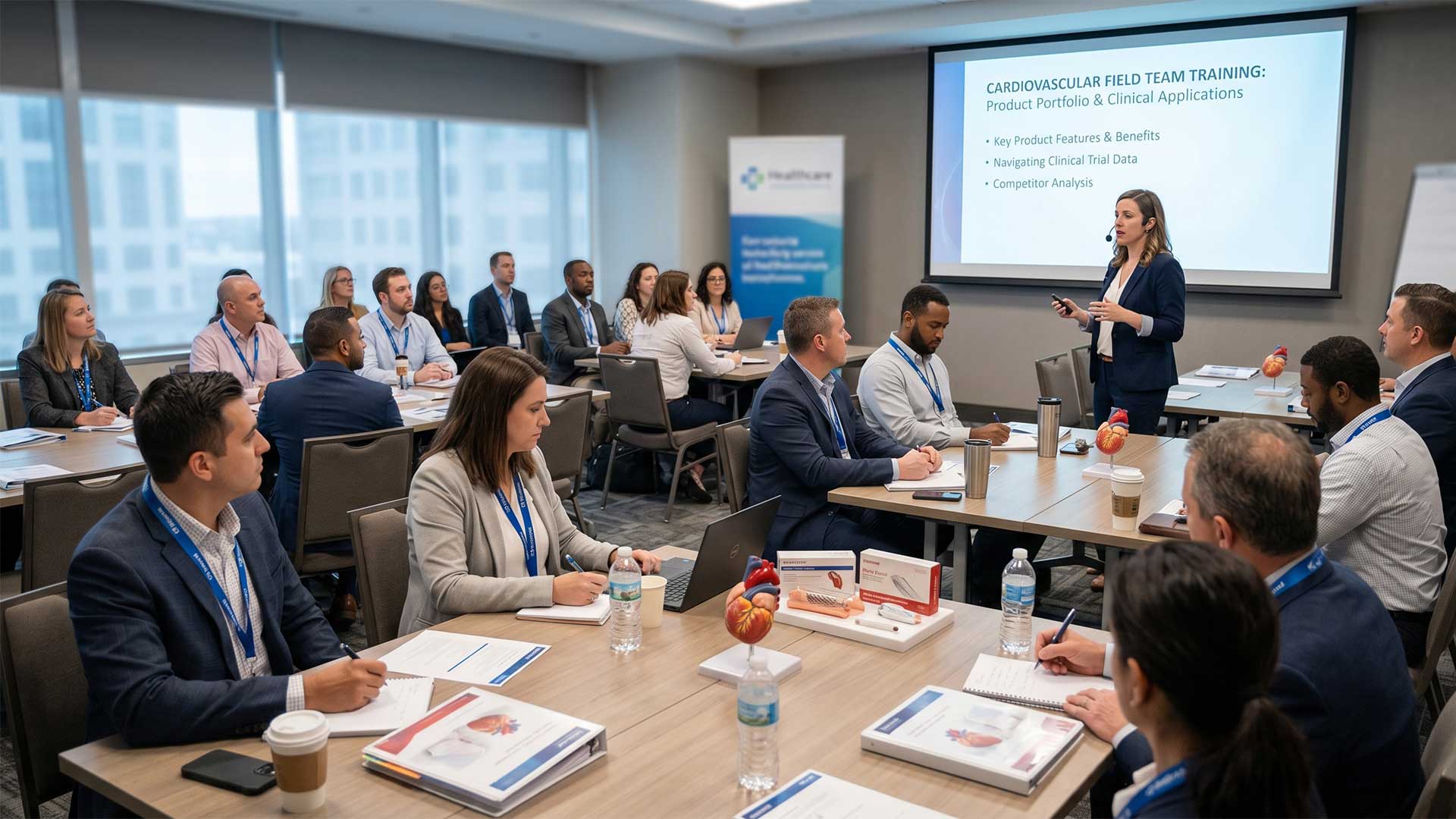

A global vaccine manufacturer needs its field reps to explain a complex preparation method that differentiates the product from competitors. A cardiovascular pharmaceutical company needs its sales force to position a treatment across a 12-month calendar of patient milestones. Both face the same constraint that makes pharmaceutical training fundamentally different from every other industry: every word a rep says to a healthcare professional is regulated, and the consequences of getting it wrong range from warning letters to market withdrawal.
This is why off-the-shelf sales training fails in pharma. Generic selling skills — objection handling frameworks, closing techniques, relationship building — are necessary but insufficient. Pharmaceutical reps need to master product science at a level that earns physician trust, deliver messaging that stays within regulatory boundaries, and adapt their approach to different healthcare professional specialties. And they need to do all of this while the rep from the other company is sitting in the same waiting room.
Training that produces reps who can do this — consistently, compliantly, and confidently — requires a design approach built specifically for the pharmaceutical context.
What makes pharmaceutical training different
Four factors separate pharmaceutical training from standard corporate training.
The first is regulatory compliance as a design constraint. Every piece of training content must align with approved product labeling and comply with regulations governing pharmaceutical promotion. Reps cannot make claims that aren’t supported by the approved indications. They cannot share data that hasn’t been through the medical-legal-regulatory review process. This means the training content itself goes through compliance review before deployment — adding time, complexity, and a layer of stakeholder management that doesn’t exist in other industries.
The second is scientific complexity. Pharmaceutical reps aren’t selling software features or financial products. They’re discussing mechanisms of action, clinical trial data, dosing protocols, contraindications, and adverse event profiles with physicians who have medical degrees. The training must build genuine product knowledge — not just talking points. A rep who can’t answer a physician’s follow-up question about a clinical endpoint loses credibility that no relationship skill can recover.
The third is audience segmentation by healthcare professional type. A primary care physician needs different information than a specialist. A hospital pharmacist evaluates different criteria than a nurse practitioner. A single product training program that doesn’t segment by HCP type produces reps who deliver the same message to every audience — and that message resonates with none of them.
The fourth is the speed of change. New clinical data, updated prescribing information, competitive launches, and formulary changes can alter the messaging strategy mid-cycle. Training content that was accurate in January may be outdated by March. The program architecture must support rapid updates without rebuilding the entire curriculum.
The scenario-based approach that works
The most effective pharmaceutical training puts reps in simulated physician interactions and asks them to navigate the conversation. Not a quiz about product features. A conversation.
A strong pharmaceutical scenario starts with a realistic setup: a specific HCP type, a clinical context, and a reason for the visit. The rep enters a virtual detail — a simulated face-to-face interaction — where the physician asks questions, raises objections, mentions competitors, and tests the rep’s knowledge. The rep chooses how to respond at each decision point.
The power of this approach is that it builds three capabilities simultaneously. Product knowledge is reinforced in context — not as isolated facts but as answers to real physician questions. Messaging compliance is practiced under pressure — the rep learns to stay on-label when the physician pushes toward off-label territory. And clinical selling skills are developed through repetition — the rep practices identifying the right message for the right HCP in the right clinical situation.
We built this approach for a global vaccine portfolio where the key differentiator was the preparation method. Reps needed to explain a complex scientific process in terms that resonated with different HCP audiences. The training used branching scenarios where each HCP type asked different questions and responded differently to various messaging approaches. Post-training, objection handling scores improved 24%. Global completion reached 90%. Rep product confidence rose to 4.3 out of 5.
For a cardiovascular product with a 12-month treatment calendar, we designed scenarios that followed the patient journey from diagnosis through long-term management. Reps practiced positioning the product at each phase — initiation, titration, maintenance — with messaging adapted for cardiologists, internists, and primary care physicians. Phase-specific messaging accuracy improved 21%.
Building the product knowledge foundation
Before reps can practice conversations, they need a solid knowledge base. The most effective structure builds knowledge in three layers.
Layer one is science fundamentals. Disease state education, mechanism of action, pharmacology basics, and the clinical evidence that supports the product’s approved indications. This layer is self-paced eLearning — interactive modules with knowledge checks that confirm understanding before advancing. Most reps have science backgrounds, but the specific therapeutic area may be new. Don’t assume baseline knowledge.
Layer two is product-specific mastery. Approved indications, dosing and administration, clinical trial results, safety profile, contraindications, and the specific claims reps are authorized to make. This layer combines eLearning with reference tools — quick-access guides for clinical data, approved messaging documents, and competitive comparison frameworks. Reps need to know this cold, and they need to find specific data points quickly during or between HCP interactions.
Layer three is competitive context. How the product positions against alternatives, what the competition’s reps are saying, and how to handle competitive objections without making non-compliant comparative claims. This is the most nuanced layer and benefits most from scenario-based practice.
Managing the medical-legal-regulatory review
Every pharmaceutical training program goes through MLR review — the process where medical, legal, and regulatory stakeholders verify that all content is accurate, balanced, and compliant with promotional regulations. This process adds 2 to 6 weeks to the development timeline depending on the organization and the content’s complexity.
Smart program design accounts for MLR from the start. Submit content for review in batches aligned with your development phases — not as a single massive package at the end. Build the storyboard with regulatory reviewers in mind: tag every claim, link every data reference to its source, and flag any content that approaches the boundary of approved messaging.
The most common MLR delay isn’t reviewer bandwidth — it’s ambiguity. When reviewers can’t tell whether a claim is supported or a visual could be interpreted as off-label promotion, they flag it for discussion. Reducing ambiguity in your storyboard reduces review cycles. Clear sourcing, explicit claim-to-reference mapping, and proactive annotation of edge cases accelerate the process significantly.
Role-based learning paths for different field teams
Pharmaceutical organizations typically have multiple field-facing roles that need different training at different depths.
Sales representatives need the full product knowledge stack plus clinical selling skills, objection handling, and HCP-specific messaging. This is the largest audience and the primary focus of most pharmaceutical training investments.
Medical science liaisons need deeper scientific training, clinical data interpretation skills, and the ability to engage in peer-level scientific exchange with KOLs. Their training emphasizes data literacy over selling skills.
Key account managers need institutional knowledge — formulary processes, hospital decision-making dynamics, and value-based contracting concepts — alongside product knowledge.
Market access teams need payer-focused training: health economics data, reimbursement landscape, and the ability to present value arguments to formulary committees.
Building all of these as a single monolithic program wastes everyone’s time. The effective approach uses a shared knowledge base — common product knowledge modules that everyone takes — with role-specific tracks that branch into the depth each role requires.
Measuring pharmaceutical training impact
Standard completion and assessment metrics apply, but pharmaceutical training adds industry-specific measures.
Messaging compliance is tracked through field coaching observations and call monitoring. Are reps staying within approved messaging? Are they making unsupported claims? Post-training compliance rates should improve measurably — and any gaps should trigger targeted remediation, not blanket retraining.
HCP feedback is increasingly available through speaker programs, advisory boards, and rep-reported qualitative data. Are physicians finding the rep interactions valuable? Are they asking follow-up questions that indicate genuine engagement with the clinical content?
Prescription data provides the ultimate outcome measure. While attribution to training is imperfect — many factors influence prescribing behavior — tracking prescription trends in territories where reps completed training versus territories with lower training engagement reveals directional impact.
Share of voice in competitive markets indicates whether reps are successfully differentiating the product. If trained reps are winning more physician mindshare in competitive situations, the training is contributing to commercial performance.
Keeping content current without rebuilding
Pharmaceutical training content has a shorter shelf life than most industries. New data, updated labels, competitive launches, and formulary changes require content updates throughout the year.
The architecture that supports this is modular by design. Each module covers one topic area — mechanism of action, clinical data, safety profile, competitive positioning — and can be updated independently. When new clinical data is published, you update the clinical data module and its associated scenarios without touching the rest of the program.
Microlearning supplements between major updates keep reps current. A five-minute module on a new competitive launch, a quick scenario on handling a new objection, or an update on a formulary win can be developed and deployed in days rather than weeks.
The annual training cycle still exists for comprehensive refreshers and certification. But the continuous learning model — major modules supplemented by frequent microlearning — keeps reps sharp between annual events and reduces the volume of content that needs to be crammed into a single training period.
What to look for in a pharmaceutical training partner
Not every eLearning agency understands pharma. The regulatory constraints, the scientific complexity, and the MLR process are unfamiliar territory for agencies that primarily serve other industries.
Look for experience with regulated content. Ask whether the agency has been through MLR review cycles and how they structure content for regulatory approval. If they don’t know what MLR means, they’re not ready for pharma.
Look for scientific writing capability. The ability to translate clinical data into training content that’s accurate, accessible, and compliant is a specialized skill. Ask to see examples of clinical content they’ve developed.
Look for scenario design that reflects real HCP interactions. Generic sales training scenarios don’t work in pharma. The scenarios should reflect the actual conversations reps have — with realistic physician questions, competitive objections, and compliance guardrails built into the interaction design.
And look for a partner who treats the MLR process as part of the project plan, not an obstacle. The best pharmaceutical training partners build their timeline around review cycles and maintain relationships with the types of reviewers who approve promotional content.