Gamification is one of the most overpromised and underdelivered concepts in corporate training. Vendors pitch leaderboards, badges, and points as the solution to learner engagement — and organizations buy in, expecting magical improvements in completion rates and knowledge retention.
Sometimes gamification delivers. More often, it produces a brief spike in engagement followed by a return to baseline, leaving behind a collection of meaningless badges that nobody cares about.
The difference between gamification that works and gamification that wastes budget comes down to one question: does the game mechanic serve the learning objective, or does it distract from it?
What gamification actually means in learning design
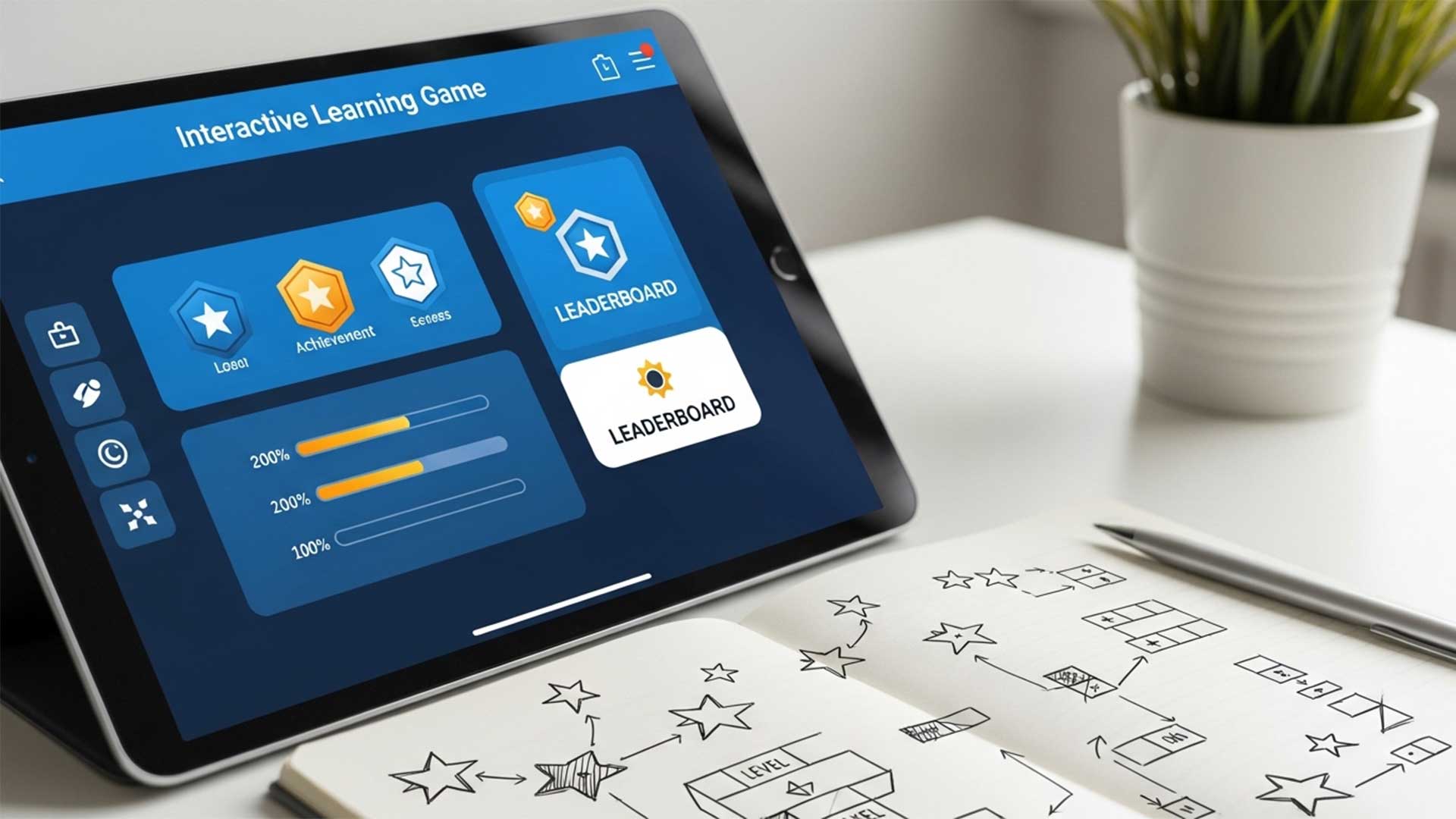
Gamification in eLearning means applying game design principles — not game aesthetics — to learning experiences. The distinction matters. Adding a points counter and a leaderboard to a slide deck isn’t gamification. It’s decoration.
Real gamification borrows the mechanics that make games engaging: clear goals with visible progress, meaningful choices with consequences, increasing challenge that matches growing skill, immediate feedback that informs the next action, and a sense of agency — the learner controls the experience rather than passively receiving it.
These mechanics work in games because they align with how the brain processes learning. Clear goals reduce cognitive load. Meaningful choices create engagement. Progressive difficulty keeps the challenge in the zone where learning happens — hard enough to require effort, not so hard that it causes frustration.
Where gamification genuinely improves outcomes
Gamification works best when the learning objective involves practice, decision-making, or behavioral repetition. There are three contexts where the evidence is strong.
The first is scenario-based decision practice. When learners face realistic situations and make choices with visible consequences, the game mechanic of choice-and-consequence maps perfectly to the learning objective. A compliance training module where learners navigate gray-area ethical situations — and see the realistic outcome of each decision — uses gamification to build judgment, not just engagement.
The second is spaced repetition for knowledge retention. Quiz-based games that revisit key concepts at increasing intervals use the spacing effect — one of the most robust findings in learning science. When the game mechanic rewards consistent practice over time rather than one-time cramming, retention improves measurably.
The third is competitive skill building in team environments. Leaderboards work when the competition is between teams rather than individuals, when the metric being measured is genuinely meaningful, and when the time frame is short enough to maintain interest. A two-week sales training challenge where teams compete on scenario assessment scores can drive engagement that individual completion tracking can’t match.
Where gamification fails — or actively harms learning
Gamification fails when the mechanic conflicts with the learning objective or creates perverse incentives.
Points for completion are the most common failure. When learners earn points simply for finishing modules, the incentive is to click through as fast as possible — which is the opposite of learning. The metric being gamified (speed of completion) has no relationship to the outcome you want (knowledge and skill).
Leaderboards in mandatory training create resentment rather than motivation. If every employee must complete the same compliance course, ranking them against each other measures nothing meaningful — the fast completers aren’t better learners, they’re faster clickers. Leaderboards work for voluntary, competitive contexts. They backfire in mandatory, compliance-driven ones.
Badges without meaning are the most wasteful implementation. If a learner earns a “Compliance Champion” badge but neither they nor anyone else knows what it signifies, what behavior it recognizes, or what benefit it carries — it’s a decoration that cost money to build and delivers nothing.
How to evaluate whether gamification fits your training
Before adding any game mechanic to a training program, ask three questions.
Does the mechanic reinforce the learning objective? If the objective is building judgment, scenario-based choices with consequences reinforce it. If the objective is factual recall, spaced repetition quiz games reinforce it. If the objective is completing a mandatory course, no gamification mechanic helps — it’s a compliance requirement, not a motivation problem.
Does the mechanic create the right incentive? If points reward speed, learners will rush. If leaderboards rank completion, learners will click through. If badges recognize something meaningful — like achieving a mastery score on a difficult assessment — they carry weight. Design the incentive before you design the mechanic.
Is the investment justified by the expected outcome? Gamification adds development time and cost. A well-designed branching scenario takes significantly more development hours than a linear module. The investment is justified when the content involves high-stakes decisions, when engagement has been a documented problem, or when the training will be delivered at scale to thousands of learners. For a 50-person team completing a straightforward process training, the ROI of gamification rarely justifies the cost.
The practical approach: start with learning design, add game mechanics where they serve
The most effective approach treats gamification as a design tool — not a strategy. Start with clear learning objectives and an instructional approach that serves them. Then evaluate which specific moments in the learning experience would benefit from a game mechanic.
Maybe the module opens with a scenario that gives the learner agency and stakes. Maybe knowledge checks use a spaced repetition engine that adapts difficulty based on performance. Maybe team-based challenges create social accountability for a time-limited initiative. These are targeted applications — not wholesale gamification of everything.
The organizations that get the most value from gamification are the ones that use it surgically. The ones that get the least are the ones that apply it as a blanket solution to an engagement problem that has deeper roots.